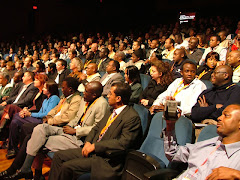
A National day on Solar power was recently celebrated in Dar es Salaam with a number of solar companies that emerged to showcase their products in an open exhibition at Mnazi Mmoja ground which was attended by the general public. This is a very important day nationally as it reminds the people on the importance of the solar power energy to their national economy. You don’t have the need to wait for the electricity power from the national grid, when there is an alternative means to solve your problem immediately” one stakeholder of the solar energy power industry remarked in a workshop held recently in Dar es Salaam. It was a great occasion indeed as many stakeholders emerged to showcase their products to the general public. Just continue enjoying this pictorial scene.
 This is a placard carryinng the message portraying a national day of solar energy power which was placed at the entrance leading to an exhibition ground at Mnazi Mmoja ground.
 Insufficiency of electricity power generation from the major hydro-electric power stations in the country such as, Mtera, Kihansi Nyumba ya Mungu dams is a major cause for many people and companies to resort power generation from other alternative energy sources in order to keep abreast with their business activities. The alternative sources of power generation are the solutions because they are viable and affordable. They can help run the country’s economies even in the absence of hydro-electricity power generation.
 Rex Investment Limited is a solar energy contractor in the country. It’s a local Tanzanian company which was established in 2000 and has been registered by the Contractors’ Rwegistyration Board (CRB) as a specialist contractior grade one. The firm is sopeciaolised in importing and selling solar panels
Due to insufficiency of electricity power supply currently facing Tanzania, many business entities have resort to the use of especially diesel generators and solar energies for power supply. In order to curb the persisting situation, big organizations, companies, individuals and other business enterprises in the country such as Rex Investments Limited and others who are in the dire need for cheap source of power supply have managed to keep working their business transactions by using alternative power source generation. With the generator machines, despite of their expensiveness, it’s the most reliable of all alternative source of power generation. Generating power machines are among the five basic sources of power supply. Others are wind, gas, nuclear, solar energy and coal.
 During the national celebrations of the solar energy day, the occasion had brought together many stakeholders in the solar energy sector and one of the companies were Phocos. This is a German based company which is operating here in Tanzania as an investor in the solar power sector supplying solar energy. Phocos is one of the largest suppliers of off-grid power supply system components in the world. Headquatered in Ulm, Germany.
 Generators are the second to be valued in the absence of hydroelectric power energy, followed by solar energy in terms of use. Generators come in handy as back-up energy sources when the local power grid, that is dependent on 80 percent hydro energy in the country fails to deliver. The selection of an internal combustion engine for independent power generation is very crucial for an efficient power supply.
 Phocos develops, designs and manufactures products to suit the needs of all stakeholders in the global solar power market. The firm is strongly committed to developing and producing products that meets their strict specifications in terms of quality, innovation and technology. The firm’s highly skilled research and development teams works in close collaboration with the University of Applied Science of ULM and distinguished institutes of Germay to produce components which greatly enhance the life span of the battery and improve the efficiency of the sector power system.
Energy which is saved by improvements in efficiency provides the greatest environmental benefit at the lowest cost. Building insulation, fluorescent lighting, and public transportation are some of the most effective means of conserving energy. Some analysts say, the power cuts currently affecting Tanzania could be the first sign of the drought’s economic impact. Under the persisting situation caused by water levels at the dam’s hydro-electric power station, this has resulted into a day time power cuts that sometimes lasts for 16 hours up from 8.5 hours.Tanzania’s total generation capacity is 953 MW of which more than two thirds is hydro-electric. To plug the power shortfall, the National Power Utility Firm (TANESCO) also intends to rent generators from outside the country.
 Direct Foreign Investments in Tanzania has really increased the degree of the internal use of solar energy power.
According to President Jakaya Kikwete, the drought had slashed hydropower capacity to close to 50 MW, out of a total capacity of 56. Tanzania hopes to generate more power from natural gas and coal both available in the country so as to relieve its reliance on hydro-power generation. He says, his government would boost gas powered generation by an additional 300 MW and start generating another 200 MW from coal. Whenever the power goes out in Dar es Salaam city which consumes almost 65 percent of the hydro power MW in the country, generators clatter into life and sellers of the designated diesel powered machines report brisk business. In today’s competitive market, it is important to be able to get the key best engine generating set package. Key considerations are the price and availability of alternative fuels the type of duty the set will be required to perform.
 GS power installations (PTY) Ltd deals with competitive security electrics fensing, intelligent power gate motors, electric security and perimeter control systems. The company is continually striving for an increase services on security systems with special emphasis and the emerging market. The company’s success is based on high quality work as well as professional development of skills and capabilities and above all, their commitment to the mission, the visions and the practice of the work values.
Many operators nowadays are in the market for standby or emergency power particularly for maintenance of essential services such as Information Technology departments, computers and communications. However, if one need a factory away from the grid, he or she may need a base load generator designed to operate in constant load 24 hours a day if the grid is not reliable, especially at critical times of the day.
 Ms. Brenda Kazimili, is a facilitator on Solar energy under Tanzania Solar Energy Association (TASEA). She is explaining a point on solar energy power to show goers who visited her stand during the national day on solar power recently at Mnazi mmoja grounds in Dar es Salaam. Mr. Brenda trains a course for technicians artisan and users on solar PV systems. She is a University graduate and currently working under the department of physics at the University of Dar es Salaam for TASEA as a facilitator on the use of solar energy power countrywide.
Today most generators run on diesel, and also there are natural gas variants and biogas is used in some specific markets. Natural gas is now widely available in many countries and sounds like a viable alternative. With reliable generators, someone’s businesses would be independent of vagaries of the local grid. This would certainly go long way increasing the productivity of the business.
 This is Ensol Tanzania Limited, the dfirm is a solar energy equipment supplier and specialist contractor as well. The firm is after a cost effective system which will provide good long term service, ENSOL (T) Ltd designs a custom power back-up system which matches the power equipment to a customer’s crucial load.
Building contractors use generating set exceedingly, often requiring site use plant that will be operated continuously. In the long term, the operation would be intermittent with major load variations as and when a tower crane is swung into action. As the sun heats up the Earth unevenly, winds are formed. The kinetic energy in the wind can be used to run wind turbines, some capable of producing 5 MW of power. The power output is a function of the cube of the wind speed, so such turbines generally require a wind in the range 5.5 m/s (20 km/h), and in practice relatively few land areas have significant prevailing winds. Luckily, offshore or at high altitudes, the winds are much more constant.
 An attendant responds questions to visitors who wanted to know how Chromagen Solar Energy Systems works. This was during the recent national day celebrations on solar energy power which was held at Mnazi Mmoja grounds.
Wind strengths vary and thus cannot guarantee continuous power. Some estimates suggest that 1,000 MW of wind generation capacity can be relied on for just 333 MW of continuous power. Energy in water can be harnessed and used, in the form of motive energy or temperature differences. Since water is about a thousand times heavier than air, even a slow flowing stream of water can yield great amounts of energy.
 People gets information about Chromagen Solar Energy systems how is works. This is an Israel’s leading manufacturer of Solar Energy Systems. The firm specialises in design, manufacturing and distribution of all solar energy equipment for domestioc, commercial and industrial use. The firm manufactures the solarsonic collector. The firm has been in operation for over 30 years and its products institutes in the European Union and worldwide. In the photo above, an attendant who is partly hidden is showing her show goers on how the machine works.
Hydroelectric power is probably not a major option for the future of energy production in the developed nations because most major sites within these nations with the potential for harnessing gravity in this way are either already being exploited or are unavailable for other reasons such as environmental considerations. The solar panels (photovoltaic arrays) on this small yacht at sea can charge the 12 V batteries at up to 9 amperes in full, direct sunlight. Since most renewable energy is ultimately "solar energy" this term is slightly confusing and used in two different ways, firstly as a synonym for "renewable energies" as a whole and secondly for the energy that is directly collected from sunlight. Obviously the sun does not provide constant energy to any spot on the Earth, so its use is limited. Solar cells are often used to power batteries, as most other applications would require a secondary energy source, to cope with outages. Some homeowners use a solar system which sells energy to the grid during the day, and draw energy from the grid at night; this is to everyone's advantage, since power demand for air conditioning is highest during the day.
 Few people in Tanzania have access to energy services that can foster development and reduce poverty. According to a principal official of the Tanzania Traditional Energy Development (TaTEDO), Thomas Mkunda, energy in rural areas is used for cooking, heating and lighting, baking and roasting at domestic, commercial and institutional levels. TaTEDO is promoting the use of appropriate modern energy technologies for poverty reduction and environmental conservation in three zones in Tanzania namely Northern, Lake and Eastern zones.
Geothermal energy ultimately comes from radioactive decay in the core of the Earth, which heats the Earth from the inside out, and from the sun, which heats the surface. Usually, the term 'geothermal' is reserved for thermal energy from within the Earth. Geothermal electricity is created by pumping a fluid (oil or water) into the Earth, allowing it to evaporate and using the hot gases vented from the earth's crust to run turbines linked to electrical generators. The geothermal energy from the core of the Earth is closer to the surface in some areas than in others. Where hot underground steam or water can be tapped and brought to the surface it may be used to generate electricity. Geothermal heat from the surface of the Earth can be used on most of the globe directly to heat and cool buildings. The temperature of the crust a few feet below the surface is buffered to a constant 7 to 14 °C (45 to 58 °F), so a liquid can be pre-heated or pre-cooled in underground pipelines, providing free cooling in the summer and, via a heat pump, heating in the winter. Other direct uses are in agriculture (greenhouses), aquaculture and industry.
 This is also the stand belonging to GS power installation as it shines in the eyes of its visitors.
The present consumption of geothermal energy does not in any way threaten or diminish the quality of life for future generations, consequently, it is considered a renewable energy source. Plants use photosynthesis to store solar energy in the form of chemical energy. Biofuel is any fuel that derives from biomass. Typically biofuel is burned to release its stored chemical energy. Research into more efficient methods of converting biofuels and other fuels into electricity utilizing fuel cells is an area of very active work. Biomass, also known as biomatter, can be used directly as fuel or to produce liquid biofuel. Agriculturally produced biomass fuels, such as biodiesel, ethanol and bagasse. (often a by-product of sugar cane cultivation) can be burned in internal combustion engines or boilers.
 Chloride Exide (T) Limited also participated in the exhibition, the firm being the leader in the renewable energy systems, seeks to maximize use of renewable energy in sub-saharan region of Africa. At Chroride Exide, a company that is also based in Kenya maintains a full range and stock of quality panels, and balance of systems suported by a knowledgeable sales team and highly qualified technicians so as to meet any consultation and installation requiments. This is part of the internal view of the entire Mnazi Mmoja ground, a popular place to conduct national celebrations.
 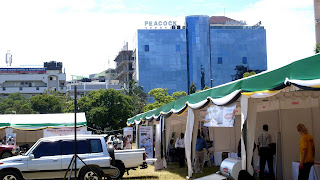 The Mnazi Mmoja ground has become a popular place for exhibitions and a place to commemorate important national occassions. It’s also a place to conduct various national ceremonies, geographically the area is centred and is within the Dar es Salaam Central Business District. This ground is a property of the Dar es Salaam city Council and was inaugurated during the occasion to mark the 38th anniversarry of the declaration of the Dar es Salaam to become a city in 1962. The inauguration ceremony was held in 1999.