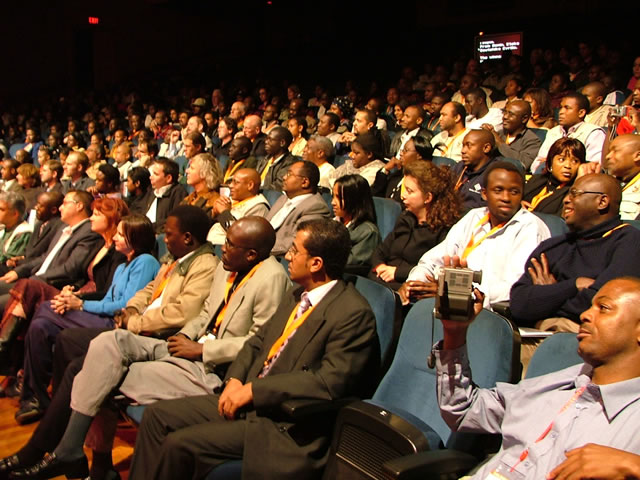
Deputy Minister for Transport, Dr. Charles Tizeba addressing invited guests (not in the picture) during the launching of Fastjet plane, a low cost flight carrier in the country.Monday, December 10, 2012
Airport authorities urged to take precautions amid influx of passengers
THE Government has alerted airport authorities at Kilimanjaro International Airport and Mwanza airports to take early precautions in order to curb with the expected influx of passengers likely to occur at their airports. Remarks by the government were issued two weeks ago in Dar es Salaam by Deputy Minister for Infrastructure Dr. Charles Tibeza during the unveiling of the Fastjet airbus A319 low cost airline carrier that took to the skies for the first time in the country with passengers in a round trip journey from Dar es Salaam to Mwanza. Dr. Tibeza said that, fear has amounted at these airports with the looming influx of passengers who have turned up to book in large numbers to board an airbus plane which has opened its business in the country and come up with a strategy of offering low cost fare to its passengers. He said the passenger increase will be a great challenge to the government as according to operators, have been selling more than 100 flight tickets in a day for a domestic flight between Dar es Salaam and Kilimanjaro, and Dar es Salaam and Mwanza respectively.
Deputy Minister for Transport, Dr. Charles Tizeba addressing invited guests (not in the picture) during the launching of Fastjet plane, a low cost flight carrier in the country.
Dr. Tibeza has also asked the operators to clarify their tickets and flight schedules to the public in order to avoid any confusion which might arise between them and the passengers especially on their fare rate of $ 20 (Sh. 32,000) per trip destinations. Dr. Tibeza is in the view of the fact that, many Tanzanians do not believe the fare rates as they compare the fare for a normal bus operating from Dar es Salaam all the way to Mwanza and takes approximately 16 hours to arrive charges its passengers between Sh. 40,000 for ordinary bus and Sh. 45,000 for luxury. How comes that, a highly expensive airbus like this one here equipped with highly expensive facilities charges much lower in a journey that lasts within one hour or less? Queried one businessman, Shabir Iqbar a Tanzanian of Asian origin doing his businesses in Mwanza city. In clarification, the Chief Executive Officer of the Fastjet air company Edward Winter noted that, the average fares are expected to be $ 80 (Sh. 120,000) but now start from as low as $ 20 one-way excluding taxes and other charges for customers who book early. Meanwhile, the government has attracted investments in infrastructure development and has put in place requisite environment for private sector’s involvement in infrastructure development and air service provision which go hand in hand with legal and regulatory reforms. In view of this the government would continue with the improvement of infrastructure in its biggest airports in the country so as to ensure that the industry operates more efficiently.
Quality control agent stresses on the limitation of imports
TANZANIA Bureau of Standards (TBS) has said that, one way to protect local industries to fair in business with other partners in East Africa region is to introduce a policy which would limit and prevent the importation of substandard goods in the country. TBS Director of Quality Management, Dominic Mwakangale said recently in Dar es Salaam that, the move would give a little chance for the unscrupulous importers to think of ordering faked and counterfeit goods which have become a menace to local consumers in the country. Analyzing his point, he said that, the freedom which the government has given importers is what has brought such a problem in local market which currently is flooded with about 20 percent substandard goods in circulation at a local market. The TBS boss said when he had just presented his paper to industrialists during a one day symposium organized by Tanzania Confederation of Industries (CTI) under the theme titled, “The role of pre-shipment verification of conformity to standards (PVoC) in curbing counterfeit and substandard goods in Tanzania”. During his presentation, he hailed the government of Kenya (a member state of EAC region) for its efforts and strictness towards the importation of sub standard goods and has reduced the circulation of sub standard goods to a greater extent in their country. However, giving the available statistics within the East Africa region, he said and added that, Kenya has managed to control the illegal importation of goods by 75 percent, and added that, Tanzania has virtually done little compared to other EA states to help its industrialists. He noted that, there is a common language used by traders in local market when a buyer of an imported product goes to their shops to purchase commodities, who have a tendency of asking their customers if they could want genuine or sub standard goods which have been categorised in different prices. The introduction of Pre Shipment Verification of Conformity to Standard by TBS is one of the strategies the government is taking to deal with such goods, he said and named three International companies which have been assigned by TBS outside the country to ensure that, they do inspection of goods before allowing their importation into the country. The companies are Intertek, Bureau Veritas and SGS.
Meanwhile, the government has called for a joint collaborative effort among industrialists, traders and importers to help curb with the increased sale of the substandard goods which have to a certain extent has agreed to have flooded local market in the country. The call by the government has come after having realized failure by the responsible organs which has been given the task to control the situation, and seemingly their strengths have been overwhelmed with a move to curb the vice being practiced by the unscrupulous traders including importers of such goods. The Minister for Trade and Industries Dr. Abdalah Kigoda made the concern yesterday in Dar es Salaam when addressing industrialists as a guest of honour during the 20th Annual General Meeting of the CTI organization. He named the Fair Competition Commission (FCC), TBS, the Tanzania Food and Drugs Authority (TDFA), the Weight and Measures Agency (WMA) and other relevant government and private sector institutions including CTI, and argued to effectively ensure that the relevant laws and regulations that deal with counterfeit and sub-standard goods are enforced. However, he has also asked them to help reveal those who are in one way or another are directly involved in such malpractice. He said the presence of such goods has been tarnishing a good name of our country at a local market level, and more worse have been causing economic hazards to consumers and their safety which has to a greater extent reduced the production capacity of the local goods produced by local industrialists. “While the government is determined to eliminate the sale and manufacture of sub-standard and counterfeit goods in Tanzania, it cannot succeed on its own. I request all Tanzanians, traders, manufacturers and consumers to join forces with the Government to expose those who are involved in the trading of those goods” he said. However Dr. Kigoda has urged consumers not to encourage the existence of such goods through being cheated by low prices which are normally attached to sub-standard and counterfeit goods. “More importantly, I urge manufacturers and consumers to expose all those who deal in these goods so that the Government can take appropriate measures”. he affirmed.
Dr. Mwapachu highlights weaknesses in EAC regional bloc
DONOR dependency on resources for infrastructure development, coupled by the major weakness of the East African Community treaty for its failure to create the conditions for enabling people’s centeredness integration to take place within the region, has been described to be among the major weaknesses existing within the regional bloc. These are among several factors that impends the development of the East African Community as highlighted in a book entitled “Challenging the frontiers of African Integration”. The book has been compiled by former Secretary General of the East Africa Community (EAC) Ambassador Dr. Juma Mwapachu. The 414 paged book was launched two weeks ago in Dar es Salaam in a colorful ceremony which was attended by book authors, publishers, educational stakeholders, including among the government dignitaries, former Attorney General Mark Bomani, Chief Justice Othman Chande and a former cabinet Minister Sir. George Kahama and was graced by former OAU Secretary General Salim Ahamed Salim. Dr. Mwapachu has stressed in his book that, despite the immense progress made by the EAC in deepening integration and fast tracking economic integration amongst the partner states is that more work needs to be done. This is especially so in bridging the knowledge and interest divide between the political elite and private sector who are engaged with the regional integration process on a daily basis and the regular people within the community who are still not aware of the milestones that make up EAC. However, he said this is a problem which needed to be worked upon collectively in order to change the attitude to let the people of EAC to have a sense and culture of East Africaness, something he said the father of the nation Mwalimu Julius Nyerere made reference to many times. “We need to bolster this identity” he said. Dr. Mwapachu uses the example of ECOWAS and how despite the diverse cultural environment the people of West African member states have a free movement which has promoted a sense of West Africaness. But we in East Africa share so much in culture, language and share experiences that the notion of East Africannes should be easy to harness. The 414 paged book which focuses on the dynamics of policies, politics and transformation in the East Africa Community (EAC), is the author’s achievement in documenting his insight on the challenges and achievements in the period of his five years of leadership as Secretary General of the East African Community from 2006 to 2011.
Former EAC Secretary General Dr. Juma Mwapachu seated extreme right following the proceedings during the launching ceremony of his book. Others in the picture are former OAU Secretary General Salim Ahamed Salim (left), and centre is the Chief Justice Othman Chande.
The book gives a highlight of the development of the partner states and their way forward to better achievements in terms of political, social and economic grounds and the framework of their policies which are enjoined to be worked for the benefits of the people in the jurisdiction of the community. Speaking during the launching, Dr. Mwapachu challenged educational donors in the country urging them they shouldn’t only donating desk materials, but also build libraries and supply educational books to primary and secondary schools. He said that, it was shaming to see most secondary schools in the country do not have libraries and enough books while in some schools students are seated in good desks which have been donated by well wishers including companies as part of their Social Corporate Responsibilities (SCR). In view of this, Dr. Mwapachu has appealed to well wishers and government to donate part of their money as an incentive so as to help students get educational books for studies. Comparing with the time he was learning in secondary school in 1960s, he noted that, all schools in the country were well equipped with libraries, laboratories and had enough books for studying. Unlike today, the former envoy has also thrown a challenge to the government which he said does not have a culture of supplying enough books to meet the demand of students in schools despite of efforts it had shown of constructing many secondary schools in the country, but most lacks reading materials. Judging from the experiences and compared Tanzania with other neighboring East African countries such as Kenya and Uganda, he noted that, the two countries have put seriousness in education an aspect that if Tanzania won’t wake up now, is likely to loose opportunities in EA common market. His remarks went alongside with the insistence to government retirees whom he urged to engage in publishing books or reports of their experience of long service in order to honour our African culture and way of life. “Many retirees do not leave behind reports to be used as reference to the coming generation” he said and added that, this is why Tanzania does not have enough publishers with interest to write about Tanzania and others. In view of this, he has congratulated few academicians like Professor Shivji and Professor Rwekaza Mukandara both of the University of Dar es Salaam for their contribution. Former OAU Secretary General Dr. Salim Ahamed Salim who graced the occasion described the author as vigilant for he has described into details the whole EAC framework and most problems compounded by it and how these could be tackled to pave way for the development within the region. Through his experience he also noted that, the contents highlighted in the book pages would help economic researchers from outside the region to get good contents that would enable them know the entire problems within the region which according to him is inherently part of each others’ and also how the community operates. “This publication is correct and full of reality as it has been compiled by a person who has worked in his capacity as secretary general of the member states for a period of five years consecutively as from April 2006 up to April 2011”, he said adding that, it has given him high prestige. However, he also noted that, the book is expected to be read by highly qualified researchers of all walks of life who would like to highlight issues related with the development of EAC and the economic integration of partner states, not only from that aspect of human life, but it will also help people know about the regional group.
Tanzania appeals to its partners on quick disbursement of GBS
THE Government has appealed to its development partners to adhere to the quick delivery of the General Budget Support (GBS) fund so as to enable timely arrangement of the smooth facilitation of the basic social and economic development projects for which the fund is intended for. The call by the government was issued early this week during annual review meeting between the government and the development partners who met in a one day forum organized by the Ministry of Finance with a view to deliberate the GBS expenditure of the previous year. Before winding up a summary report of the meeting to journalists, the Minister of Finance, Dr. William Mgimwa said that, some development partners have a tendency of delaying the money an aspect that sometimes results into the failure by the government to make its budget through as planned in most targeted areas such as agriculture, education, Health and Construction. He said the government and its partners agreed to enhance the dialogue for the key focus for dialogue next year which will be based on the sustainable growth, improving quality of social services at local government level and maintain public financial management and transparency. The meeting also heard about the government’s new development agenda which will be strengthening delivery across a number of critical areas such as Energy, Oil and Gas, Transport and Revenue collection services. On the other hand, the development partners have pledged to enhance predictability of the GBS disbursements on the basis of a reinforced dialogue, and there was a consensus that the continuing challenge for both partners is to support sustainable growth which benefits Tanzanian citizens at large leading them to a significant decline in poverty. The current Chairman of the development partners’ group in the country who is also the head of Britain’s Department for International Development (BDID) Marshall Elliott was quoted as saying that, this year’s commitment from the budget support has remained just under half a $ billion which is a significant contribution to the national budget. However, he said that, this is a similar level to last year which is 68 percent of the payment equivalent to $ 337 within the first quarter of this year. GBS annual review meeting is an event of the partnership framework memorandum of understanding which the government signed in 2001 with the development partners who are 12 in number to join help budget support program in the country. Its contribution has brought a significant outlook in the country’s developing economy. The aim of the annual meeting intends to provide an opportunity for the government and the GBS partners to assess the performance in implementing their mutually agreed commitments that are considered essential for Tanzania’s growth and poverty reduction. GBS is an aid delivery modality that provides financial assistance to the country’s national budget. In the case of Tanzania, the funds are provided by Development Partners (DPs) and used by Government to reach the goals of Tanzania’s National Strategy for Growth and Reduction of Poverty (popularly known as MKUKUTA for Tanzania’s Mainland and MKUZA for Zanzibar). It is up to the government to manage the money and it is spent according to the prioritizing made in the national budget, in dialogue with development partners and a unified assessment framework. This means that budget support as an aid modality leaves more of the responsibility with the recipient government than more traditional project assistance. In Tanzania, the GBS is financed by 12development Partners, 9 bilateral and 3 multilateral and these are The African Development Bank, Canada, Denmark, the European Commission, Finland, Germany, Ireland, Japan, Norway, Sweden, Netherlands, Norway, Switzerland, the United Kingdom, and the World Bank.
Tanzania to benefit from child health program initiative
TANZANIA will benefit from $ 2Million (Sh. 3.2 billion) to be donated by Standard Chartered Bank in collaboration with its partners through its ‘Seeing is Believing’ Program which aims to liberate children under 8 years old from visual impairment in three East African countries, it has been learnt. The amount of money is part of the total $ 6.25 million to be disbursed to three countries (Tanzania, Kenya and Uganda) to help facilitate the project which aims to provide eye treatment to reach out at least four million children in these countries starting from January 2013 and ends in 2016. Speaking in an exclusive interview over the phone in Dar es Salaam, the bank’s Corporate Affairs Manager, Beda Michael Biswalo said that, the program will also build referral networks to identify and correctly diagnose and treat children with eye problems. He said the initial payment for Tanzania would be directed to its ten regions in the country to start with as a pilot project. He mentioned the regions as Iringa, Kigoma, Manyara, Mwanza, Mbeya, Rukwa, Tabora, Morogoro, Kilimanjaro and Dar es Salaam. He said that, the Standard Chartered Bank in collaboration with its partners has invested such a huge amount of money as part of the bank’s social and corporate responsibility and specifically will target the unprivileged communities. He said, out of the total amount, his bank will contribute the largest chuck covering 80 percent of it all, while the remaining 20 percent will be contributed by their two partners a consortiums led by the Christian Blind Mission (CBM) and the Brien Holden Vision Institute based in South Africa respectively. Elaborating the aim of the project in general he noted that, the move is to directly benefit 4 million children under 8 years old through screening, treatment for basic eye problems, eye surgeries and issuing of eye spectacles.
Three weeks ago, Standard Chartered Bank Tanzania office convened a meeting alongside with the program to celebrate the launching of the East Africa Child Eye Health project which took place at Mnazi Mmoja Municipal grounds in Dar es Salaam city. The occasion brought together 15 different organisations under the banner of ‘Seeing is Believing’ a model for the delivery of child health which will directly benefit children under 8 years across East Africa region. The project launch was attended by delegates from Kenya and Uganda respectively and their host Tanzania. From Kenya the delegation was led by the country’s Minister for Medical Services Dr. Samwel Kambi, while the Ugandan delegation was led by the Permanent Secretary in the Ministry of Health Dr. Samwel Kabikule. The Bank’s Chief Executive Officer for Tanzania Jeremy Awory said in his key note address that the project is part of the global $ 100 million (Sh. 150 billion) drive as the bank’s contribution towards achieving vision 2020 which targets to completely eliminate preventable blindness among children. The bank is optimistic that as an international institution, they have the capability and a strong network to help tackle these social challenges facing local African communities as part of their social and corporate responsibilities. However, he said adding that, the progression in the Seeing is Believing initiative to support children eye health care is a great opportunity which is aimed at protecting children from blindness and visual impairment and further to enhance the lives of younger generations. The four year program is in partnership with the Ministries of Health, Medical and Education which encompasses the three East African countries who would be working in collaboration with its two partners in order to achieve the desired goals. Statistics shows that, in East Africa alone, an estimated 8,500 to 10,000 children live with blindness a disability that has serious effects on the educational and employment opportunities for children. Since its launch in 2003, $ 50 million has been raised and used to tackle avoidable blindness in disadvantaged communities across Standard Chartered’s market in Asia, Africa and the Middle East continents. The target is to raise 4 100 Million by 2020.
Tanzanians told to emulate Angola’s experience of gas extraction
AS Tanzania prepares to work on various strategic plans on how to manage the extraction of its discovered natural gas deposits in southern region of Mtwara, the Minister for Foreign Affairs and International Cooperation Benard Membe has urged the government to adopt the technology being applied in Angola, a giant economic producer of natural gas in Africa. Minister Membe made the call recently in Dar es Salaam when addressing members of various diplomatic corps accredited in the country who attended the 37th anniversary celebrations of Angola’s independence, the occasion was organized by the Embassy of Angola in the country. In his speech, Membe praised Angola for its economic advancements it has made so far since independence time and said that, it’s a country worth to be emulated by Tanzania government when it comes to gas extraction. However, he said adding that, Angola’s economic success is as a result of the cooperation amongst its citizens since the country liberated itself from the Portuguese colonial yoke way back in 1975, and that it had shown a tremendous development initiatives in its economy citing minerals and natural gas as the major economic drive which have made it to become a giant economic producer in Africa. “Angola is one of the world’s major centres for oil and gas exploration and the nation's wealth of hydrocarbon resources attracts investment in both the industry and the community”, he said adding that, apart from natural gas, and it ranks the third largest oil producer in Africa after Libya and Nigeria.
In January 2007, Angola became the 12th member of the Organization of Petroleum Exporting Countries (OPEC) and a significant supplier of its rich underground natural resources to both China and the United States. Describing its other economic features such as the infrastructure built across the country, Membe noted that, Angola has its road flyovers, and currently its government is underway to introduce a bullet train journey that would cut across southern African countries from Lubeto to Luanda and Zambia and if possible would enter in Tanzania. Other developments included housing for its people and that currently the country maintains its stance to transform the lives of its rural people at all costs in order to develop social and economic life. In view of this, he said adding that Tanzania must adopt its way of economy. Although not well known, the natural gas reserves in Angola are estimated above the 11 TCF (trillions of cubic feet), being its majority associated gas. The lack of more accurate knowledge of natural gas reserves in Angola in part is due to the absence of dedicated investment and non existence of a legal and contractual framework. Meanwhile, the Ministry of Foreign Affairs is planning to advise the government to send the current Minister for Energy and Minerals Professor Sospeter Muhongo to visit the country to acquire experience and skills of the technology used for gas extraction and exchange ideas with Angolan experts. On his part, the Angolan Ambassador accredited in the country Professor Ambrosio Lukoki noted that, Tanzania might be able to receive oil from Angola and advantageous conditions and benefit from Angola’s experience in the oil and gas industries. He said Tanzania might benefit economically from the bilateral relations which has been existing between these two countries for the last 37 years now, and added that, this is a consolidation of the excellent political-diplomatic relations between the two countries which dates back from the beginning of the struggle for national liberation. Describing social and educational development of his country, the Ambassador noted that, in order for his country to meet the demand of youths in his country, his government has established 17 national universities and has other 44 higher learning institutions for technical professional education. All these he said have been invested with an equivalent of more than $480 million for the last three years.
Tuesday, December 4, 2012
Why the sunken RSM Titanic vessel was remembered in this year’s maritime day
BETWEEN 17th and 18th September this year, Tanzania joined other nations in the world to celebrate the World Maritime Day, the occasion was celebrated under the theme titled “one hundred years after the Titanic”. The occasion had its major significance in terms of ensuring marine safety and regulations and the most practical legacies which were first introduced immediately after the accident of the luxurious marine passenger vessel, the Royal Mail Ship or ‘RSM Titanic’ which sunk in the deep sea waters of the Atlantic Ocean on its maiden voyage to New York one hundred years ago. The accident which occurred at night on the eve of April 14th 1912 after the ship struck an iceberg, is described to be the worst marine accident to have ever happened in the world since the technology of the marine vehicles came into being even before the birth of Jesus Christ. The disaster raised so many questions that alerted stakeholders about the safety standards in force after more than 1,500 passengers and crew on board died, an aspect that forced the United Kingdom Government who owned the ship to propose holding a conference to develop international safety regulations. The Conference, which was attended by representatives of 13 countries most of which from Europe, introduced new international requirements dealing with safety of navigation for all merchant ships in maritime safety since that disaster and to examine which areas of ship safety should be given priority in the years to come. The outcome of the conference saw the need to introduce safety regulations in order to provide lifeboats and other lifesaving appliances for all on board and this led to the developments in the design of lifeboats, life rafts and the means of launching them under all conditions. The regulations also encompassed international requirements which deal with safe navigation, watertight and fire resistant bulkheads, fire protection and fire fighting appliances. The conference also saw the need to introduce safety exercises which are now mandatory for all new passengers joining a passenger or cruise ship and for the crew to undertake lifeboat launching and evacuation exercises before the ship leaves the harbour. Legislation was prepared under the international adoption on Safety of Life at Sea (SOLAS) convention following the investigation of the sinking. Sadly this initiative was interrupted by the 1914/18 world war and was never ratified. The SOLAS convention had been updated and came into force in 1929, based on that of 1914 to reflect developments in technical design, scientific knowledge and seaborne trade. Today it provides the key international regulations governing maritime safety. It has always been recognized that the best way of improving safety at sea is by developing international regulations that are followed by all shipping nations and from the mid-19th century onwards a number of such treaties were adopted. Several countries proposed that a permanent international body should be established to promote maritime safety more effectively, but it was not until the establishment of the United Nations itself that these hopes were realized. In 1948 an international conference in Geneva adopted a convention formally establishing International Marine Organization (IMO). The original name was the Inter-Governmental Maritime Consultative Organization (IMCO), but the name was changed in 1982 to IMO Following the adoption of the international marine conventions from IMO, Tanzania has been striving hard to cope with the marine disasters’ international regulations but seemingly lack of seriousness over the matter coupled by insufficient knowledge, the two have been a drawback to the development of the sector, says the Minister for Transport Dr. Harison Mwakyembe. According to him, the government through the Ministry of Infrastructure is underway to propose a bill which will work as a guideline policy for rescue operational activities for marine accidents. The bill will ensure together with other things marine accidents are attended promptly.
he move by the government has come barely after Dr. Mwakyembe discovered there is a great discrepancy on marine policies which is important to be used as a guidance of all marine disasters in the country, in view of this, his office is currently preparing a bill that would help curb with the situation. The bill would be tabled in parliamentary sessions scheduled in February 2013. He came to realize the need of having this policy after having studied what had transpired in the recent two worst marine disasters along the Indian Ocean which involved MV Spice Islander which occurred in September 2011 and MV Skagit in mid of June 2012 respectively. The two recent worst marine disasters caused losses of hundreds of lives of innocent Tanzanians. Dr. Mwakyembe who is a professional lawyer has come up with the idea after having realized that little knowledge is being applied of the general idea of rescue operations due to lack of proper understanding on the whole issue. This is coupled by lack of modern rescue operational facilities that Tanzania is still faced with as a great challenge. However he noted that his office is currently working with a team of local experts on important elements from both inland and marine transport sector in the country to ensure that, a comprehensive policy on rescue operations is drafted and a law is passed to make if more effective. This year's World Maritime Day provided an opportunity to take stock of the developments of various marine policies and regulations which have been adopted by member countries in the world as important legacies not only to ensure marine safety, but also to defend the rights of workers on board. The tragic story of the sinking of the Titanic vessel as an example reveals that, all the engineers on board were lost through staying at their posts busy trying to maintain the ship’s services and putting repairs on the damaged hull for as long as they could without success. Following this, in 1912 the UK newspaper, the Daily Chronicle, initiated the Titanic Engineering Staff Memorial Benevolent Fund to assist the widows, orphans and dependents of the engineers who died so heroically at their posts below decks on that fateful night. The Titanic was not the first or the last passenger ship to sink, so what was so special about this tragedy whose memory has been kept in many ways notably books, films, documentaries and websites?
This is a newspaper cutting of a tragic story of the sunken Titanic which was carried by the New York Times by then. The designer splashed the story on the front page of the newspaper the same way as it was carried during that time in the newspaper when Milvina Dean died in June 2009.
Critics have challenged the matter as saying that it was so luxurious, boasting of many features unheard of in ocean going liners as it was considered unsinkable. Most probable the main reasons might be linked to its famous outlook so as to let the incoming generations come to know and understand her final days at sea. However, it wasn’t until 1985, when Dr. Robert Ballard, using state of the art technology, finally discovered the final resting spot of this once proud luxury liner. During the incoming expeditions conducted in a series of years in 1987, 1993, 1994 and 1996, RMS Titanic, Inc. the divers have recovered more than 5,000 artifacts from the wreck site. These artifacts were carefully preserved and have been put on display for the public in several locations in UK. There is some controversy raging over the recovery of these artifacts as some say that the Titanic is a graveyard and a memorial to all those who died on the evening of April 15, 1912. By disturbing the site and removing artifacts, they feel that the sanctity and dignity of the Titanic is being compromised. Others maintains that, the wreck is an artifact of history and the pieces recovered only help to further educate others about the Titanic. They also maintain that the sea is slowing destroying these artifacts and that left in place, over time they will vanish forever. They also feel their efforts to salvage these artifacts will help to preserve the Titanic and its memory forever. Regardless of their position on this, the story of the Titanic is a compelling one. Today, with the release of the hugely successful movie and Broadway musical, Titanic fever has gripped the public like never before. Living as we do in an age of rapidly progressing technology, it is hard for us to imagine a time when there were no radios, internet or television services. Had the Titanic tragedy happened today, we could all have been aware of the ship’s pilot Edward Smith’s initial distress signals within few minutes. Long range helicopters which were sent out from newfound land could have reached to drop inflatable life rats. The final agony of her foundering would have been witnessed on TV screens around the world. But it’s very unfortunate as the only two ways by which news was spread were by word of mouth and the daily newspapers. The Titanic then the world’s largest marine vessel was designed in England and had 883 feet long (270 meters away), 92 feet wide and weighing 52,310 tons. It was 175 feet high from the knee to the top of the four stacks or funnels almost 35 feet of which was below the water line. The ship could be seen higher above the water than most urban buildings of the time. There were three real smoke stacks with the fourth dummy stacks added to increase the impression of its size and power to vent smoke from the ship’s numerous galleys. The ship was also designed to be a symbol of modern safety technology, it had a double hull of one inch thick steel plates and a 16 water tight compartments sealed by massive doors that could be instantly triggered by a single electric switch on the bridge, or even automatically by electric water sensors. Even though the Titanic was capable of carrying over 3,500 passengers and crew, it had more than 2,200 passengers on board by then. The ship’s much publicized voyage lured British nobility, members of American society and industrialists as well as many poor immigrants hoping to begin a new life in America. The journey began at Southampton, England at noon on April 10th 1912 by nightfall, the Titanic had stopped in Cherbourg, France to pick up additional passengers. That evening it sailed for Queensland, Ireland and at 1:30pm on 11th the ship headed into the Atlantic Ocean towards New York City. Seasonal Trans Atlantic passengers were impressed by the new ship. It was so massive that they barely felt the moment of the sea at all. The huge engines produced almost none of the vibrations common on the steamers as the ship travelled comfortably at about 25 miles per hour. The weather was clear and pleasant and the water temperature was about 55 degrees Fahrenheit. The winter of 1912 had been unusually mild and unprecedented amounts of ice had broken loose from the arctic region. Titanic was equipped by Marconi’s new wireless telegraph system and the two Marconi operators kept the wireless room running 24 hours a day. On Sunday April 14, 1912 the fifth day at sea, the Titanic received five different ice-warnings but Captain Edward Smith was not overly concerned. A wireless Operator who was on duty in the fateful day, Jack Phillip was busy sending passengers’ messages to Cape Race, New found land whereupon he received the sixth ice-warning that might, but didn’t realize how close Titanic was to the position of the warning point and put the message under paper weight at his elbow. He never reached Captain Smith or the officer on the bridge. The ocean was usually calm and flat like glass according to many survivors. Lack of waves made it even more difficult to spot any ice-berg since there was no telltale white weather breaking at the edge of the iceberg. At 11:40pm, “lookout” shouted one ship officer who spotted a mass of iceberg dead ahead. He notified the crew concerned and the first officer William Murdock ordered the ship turned hard to port. He afterwards signaled the engine room to reverse direction. The ship turned slightly, but it was too large to move as fast as it was expected and the iceberg was too close.
The late Millvina Dean as he looked like one year before her death at the age of 97 years old in 2009.
Just within seconds later it hit a huge mass of iceberg and split into two before it sunk. Statistics made available shows that 711 lives most of whom were women and children were saved by few available life boats from the scene, but about 1,513 were lost due mainly to lack of enough lifeboats. The greatest maritime disaster in the history began unfolding. What really happened to unsinkable Titanic remained a great mystery until September 1985 when the ship was found some 13 miles east of its last reported position. The discovery of Titanic was helped by a joint French-American efforts which began earlier in the 1985 with a cruise aboard the French research vessel known as Lesuroit which was designed by Dr. Robert Ballard a leader of the Woods Hole Oceanographic Institution Deep submergence laboratory based in France. Its wreckage lies in two sections in more than 12,460 feet of water (about 4km deep). The bow section is upright partly buried in the bottom sand in relatively good condition spot. According to the latest reports issued by British mainstream media in early June 2009, said that, the last survivor of the total saved 711 passengers died at the age of 97. Millvina Dean, who as an infant passenger aboard the Titanic was lowered into a lifeboat in a canvas mail sack and lived to become the ship’s last survivor. She died at a nursing home in Southampton, the English port from which the Titanic embarked on its fateful voyage. The youngest of the ship’s 711 survivors, Ms. Dean was only 9 weeks old when the Titanic hit an iceberg in waters off Newfoundland on the night of April 14, 1912, setting off what was then considered the greatest maritime disaster in history. He died while having no any idea about the tragedy young as she was during the time of rescue She survived with her mother, Georgetta, and 2-year-old brother when they, like many other survivors, were picked up by the liner Carpathia and taken to New York. Her father, Bertram Dean, was among more than 1,500 passengers and crew members who died in the sinking, a fact that Ms. Dean, in an interview at the Southampton nursing home few months before her death, attributed partly to the fact that the Dean family was traveling in third class, or steerage, as the cheapest form of passage was known. She was born on 2nd Feb 1912. Millvina Dean never married and had no children. Dean's mother died on 16 September 1975, aged 96; and her brother Bertram Vere died, aged 81, on 14 April 1992.

Subscribe to:
Posts (Atom)